
The Past is Never Dead

by George Melrod
March 28, 2026
Los Angeles, California
“The past is never dead. It’s not even past.” – William Faulkner

What exactly does it mean to make America great again? Apparently, it has a lot to do with actively whitewashing its past. The crusade kicked in exactly a year ago, in March 2025, when the White House issued its executive order on “Restoring Truth and Sanity to American History.” Accusing the Smithsonian of promoting a “divisive, race-centered ideology,” it directed the Interior Department to enact a broad review, and revise — or remove — any materials that cast American history in a negative or disparaging light.
The names of Confederate generals were gleefully restored to army bases, using disingenuous logic. Descriptions of slavery, including the famous “The Scourged Back” photograph of the back of a slave crisscrossed by welts from whipping, were removed from signage, to historians’ dismay. Even positive tributes to admired icons like Harriet Tubman and deceased Black WWII veterans began to disappear. Jim Crow? Forget about it! We’re all just one big happy family!

In striking synchronicity, two powerhouse Los Angeles museum shows now engage this issue of historical erasure and remembrance head-on. Even in ‘normal’ times they’d be profoundly moving, but given the moment, they feel bracingly vital.
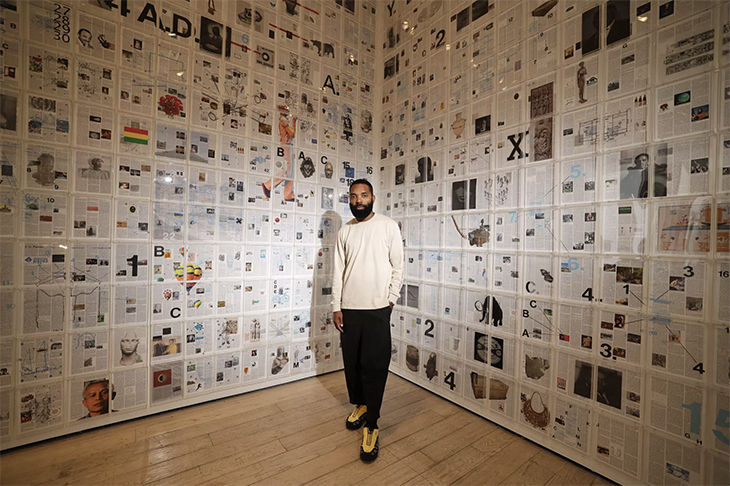
Tavares Strachan’s exuberant solo exhibition at LACMA, titled “The Day Tomorrow Began,” mines unlikely joy and hope from the annals of neglect. Encompassing a staggering panoply of disparate mediums, the show offers an “excavation of histories that have been rendered invisible within mainstream narratives, particularly in relation to the Black diaspora.” The show opens with Strachan’s quixotic attempt at inclusion, his “Encyclopedia of Invisibility” which catalogs over 17,000 entries on people, places and events that the artist sees as unjustly ignored. It fills a giant volume set in a vitrine, while collaged pages swathe the walls in an effusive patchwork of photos, facts and artworks. The Encyclopedia’s foreword includes the warning: “Ralph Ellison reminded us that invisibility comes from a refusal to see.”
Among Strachan’s pantheon of forgotten pioneers is Matthew Henson, the African American polar explorer who joined Robert Peary on seven journeys to the North Pole. He is represented by two tapestries. In homage to Henson, Strachan himself journeyed to the Pole in 2013, and planted a Bahamian flag sewn by his mother. Another is Robert Henry Lawrence, the first Black American Astronaut, who was selected for the Manned Orbital Laboratory program, but died in an accident in 1967. He’s depicted here by a small golden urn with a likeness of Lawrence’s head doubling as its cap. But it’s more than just an effigy; working with SpaceX, the artist launched a version of the piece into orbit in 2018, symbolically fulfilling Lawrence’s dream. Although the works themselves are modest, the aspirational vision informing them feels breathtaking.
The exhibition finds its magic in a garden of fantastical ceramic vessels with portraits of figures like vocalist Nina Simone and Andrea Crabtree, the first Black female sea diver in the U.S. army, that are set amid a bed of fragrant rice grass, which sensually evokes scents and symbols from Ghana. Elsewhere, installations depicting a barbershop and laundromat, both centers of Black social life in America, are brought to life by costumed performers through spoken word and song — a form of oral history. Meanwhile, a gallery of char-black statues, setting colonial conquerors and freedom fighters against one another, are presented fused at their bases. Half of them hang upside down, the implicit critiques seasoned by a giddy dose of surrealism.

If Strachan’s work seems imbued with hopeful hints of transcendence, MOCA’s ambitious exhibition titled “Monuments” confronts us with the relentless legacy of the past. Co-curated by Hamza Walker of The Brick and MOCA’s Bennett Simpson, along with Hannah Burstein, Paula Kroll and artist Kara Walker, this weighty survey juxtaposes actual decommissioned statuary with works by African American artists, some pre-existing and some created for the show. The dialogues are poetic, jarring, and often deeply sobering.
From the get-go the show grounds viewers in the conflict, with hunks of the graffiti-covered pedestal of the Robert E. Lee statue from Richmond, VA, and just beyond, an allegorical figure of the Confederacy holding up a dying soldier and a laurel wreath. Flanking it are works by two paragons of historically resonant abstract sculpture: Martin Puryear, whose refined, cagey work hides a cannon inside a Civil War kepi hat, and Leonardo Drew, who gathered massive blocks of cotton into a towering minimalist wall. A statue of oceanic scientist Matthew Maury, seated before a giant globe, dominates the center of the room. An ardent Confederate loyalist, he dreamed of expanding slavery southward into a vast Pan-American empire.

An anxious hush hovers over the gallery presenting the Jefferson Davis statue, laid out on its side, spattered with paint, and surrounded by Andres Serrano’s looming Ku Klux Klan portraits peering out from within their hoods at the fallen idol. The most poignant face-off aligns statues of Chief Justice Roger Taney, who wrote the infamous 1857 Dred Scot decision, and the obscure Wilmington, North Carolina publisher who stoked a murderous 1898 insurrection which overthrew the city’s elected biracial government. They stand opposite a wall of B&W photos from the early 1900s, by roving portrait photographer Hugh Mangum, of various anonymous Southerners, both Black and white, some overlaid atop each other on the irregular glass plate prints, gazing out in silent dignity.
The caliber of contemporary African American art in this show is impressive, whether it’s the elegiac pieta-like photographs of Jon Henry, an update of the racist cinematic opus “Birth of a Nation” by Stan Douglas, or cast bronze landscapes of Ferguson, Missouri by Khalil Robert Irving.

But the disparity in scale is formidable. Even off its pedestal, a giant double equestrian of Lee and Jackson manages to face down its counterpart, a full-sized copy of the fabled Dodge from “Dukes of Hazzard” that’s been puckishly set on end to parade the Stars and Bars on its roof. The asymmetry between these bombastic public statues, embodying the collective weight of civic authority, and the quirky visions of the individual artists selected to refute them echoes across the show. The contrast makes it clear how these monuments were not so much wistful memorials as symbols of power.
The equestrian monuments of Generals Robert. E. Lee and Stonewall Jackson in Charlottesville, Virginia were already slated for removal when the “Unite the Right” rally in 2017 rendered them toxic. The Lee statue was melted down into ingots, but the Jackson statue had a more interesting fate. It was obtained for artist Kara Walker to reimagine, which she does to stunning effect. Displayed separately at The Brick, the resulting work, titled “Unmanned Drone,” is perhaps the show’s most potent response to the trove of pro-Confederate iconography.
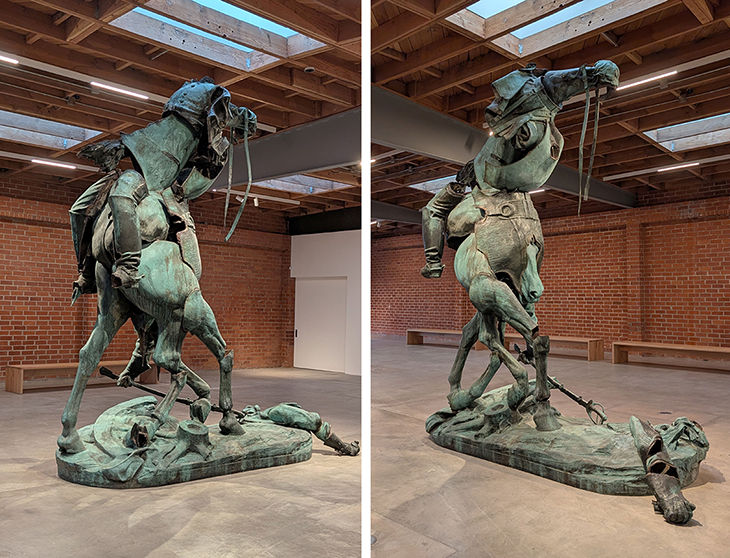
After mapping out various options Walker ultimately chose to disassemble and rebuild the statue, merging the figures of the famed Confederate general and his beloved horse, Little Sorrel. In the final work, the general’s stoic face is absent as the hulking, haunted beast rises up on its hooved legs, striding forward with the lifeless body of the fallen general laid out on its back. Exemplifying the baggage, and horror, of the Lost Cause legacy, with its Confederate nostalgia and all it stands for, the undead creature lurches forward like a reanimated Frankenstein.
Now part of MOCA’s permanent collection, “Unmanned Drone” will remain in Los Angeles, where it will continue to provoke reaction and debate for years to come. As well it should. Much as we might yearn to exorcise the anguished specter of the past and put it behind us, it clearly stalks among us still.

George Melrod has written hundreds of articles on contemporary art and culture for such publications as ARTnews, Art in America, World Art, American Ceramics, Details, and Vogue, among others. In the 1990s, he was the New York critic for Sculpture magazine, and wrote a regular contemporary art column for Art & Antiques, for whom he worked as a Contributing Editor. A native New Yorker, he moved to LA in 1998, and has since contributed to websites such as artcritical and artillery. From 2007-2017 he served as editor-in-chief of art ltd. magazine.


Comments