
“Eternal Construction”

by Liz Goldner
Laguna Art Museum, Laguna Beach
Continuing through January 18, 2026

“Eternal Construction” is a group exhibition of photographers who examine California’s constantly evolving landscape. Through the eyes of 13 individuals and one consortium of six artists, the show traverses the nexus of fine art and documentary photography, while exploring our state’s evolving relationship to land, architecture and infrastructure. The title of the exhibition reflects California’s continually built, decaying and reinvented environment. The show lends insight to the vastly versatile aesthetic aspects of recent photography even as it strives to convey optimism about the human capacity to evolve and rebuild.
That versatility encompasses images inspired by Impressionist landscape painting, the Hudson River School of painting, modern art movements ranging from minimalism, hard-edge and abstraction, meticulously staged and photographed abstract scenarios, and more.

A contact print of the original “The Great Picture” (2006) by The Legacy Project (Jerry Burchfield, Mark Chamberlain, Jacques Garnier, Rob Johnson, Douglas McCulloh and Clayton Spada) is perhaps the most important work here. The original 3,375 square foot photo portrays the control tower, structures and runways of the original El Toro Marine Air Station in Irvine, viewed against a backdrop of the San Joaquin Hills. To create the picture, the six photographers and 400 volunteers converted a jet-fighter hangar into a camera obscura and made their exposure through a 6-millimeter aperture onto a single seamless muslin canvas. The original fuzzy black and white photograph, depicting the decommissioned marine base, flanked by hi-tech Irvine, California and the undulating hills beyond, bears resemblance in subject matter and style to California’s Impressionist landscapes, especially with its cross hatching.
When The Legacy Project was formed more than two decades ago, Irvine Mayor Larry Agran and his supporters were hopeful that the burgeoning Great Park would become a world class development to rival New York City’s Central Park. But as an example of human-led environmental decline, conservative Irvine politics unfortunately shut down those plans, enabling the parkland to be built into several bland housing developments.

The contrasting black and white photos by Jacques Garnier (who was part of the Legacy Project), portraying the pared down exteriors of Southern California buildings, formally reflect Minimalism and Hard-edge abstraction. They also display skillful use of contrasting light and dark, while reflecting on our experience with the built environment. His gelatin silver print “At the Crossroad” (2015) contrasts the exterior of a large industrial building against a stark black background. The architecture is reduced to an austere brutalist design that conveys not menace but profound harmony and grace.
Garnier's “Hymns to Silence” (2021) series expressed his passion for architecture, art history and poetry. As he explained in the “Hymns” catalog, “The negative space of these deconstructed images is the pause between the notes of the music, a disruption, to make you create your own interpretation and to enjoy the silence. This emptiness allows for potential.”
Tom Lamb, a landscape, architectural and aerial photographer, contributes images shot from a helicopter. He refers to these urban landscapes, including airfields as seen from above, as “Marks on the Land.” In them, virgin land is woven among the built structures and intersections. An excellent example is “Green36” (2019) of the Ontario International Airport. The photograph transforms the airfield into an attractive interpretation of abstract expressionism. The maneuvering of the aircraft was crucial to producing a result that appears deceptively effortless. Lamb explains, “Looking toward earth, directing the pilot to spin around, dip the nose, fly sideways or backwards, and even cut the engines to float downward, all to capture the right image.”

Jeremy Kidd’s “Big Horn Palm Desert” (2014), an archival print on aluminum, presents a panoramic view of the desert town at dusk. As the most painterly visual in this exhibition, it is inspired by the Hudson River School, and includes a rocky vista with cacti in the foreground and Palm Desert in the background. The finely wrought print is actually a composite of four individual photos taken over the course of the day and evening. The show’s curator Tyler Stallings explains, “Kidd’s digitally fused landscapes contrast with more austere or documentary approaches, presenting perception itself as a constructed environment shaped through accumulation and editing.”
The architectural photos of Julius Shulman, known as “Case Studies,” contrast dramatically with the others that critically depict the built environment. Shulman’s photo of Richard Neutra’s classically modern von Sternberg House (1947) is one of several images that “are not mere records of buildings, but carefully composed celebrations of an aesthetic ethos — precision, openness, and control,” according to Stallings. The image elegantly captures the home’s sweeping lines, reflective water feature and the integration of structure and landscape. Schulman’s photographs express reverence for Neutra’s architecture, whose designs respected and harmonized with the land at a time when the boxy homes of Levittown and other manufactured communities were beginning to invade the country.

Robert von Sternberg’s colorful images of trailer parks, gas stations, and roadside structures, hung near those of Jeff Brouws’ black and white abandoned gas stations, are the virtual opposite of Schulman’s polished beauty. Theirs is a gritty hyper-realism that gropes for beauty where the rest of us only see ruin.
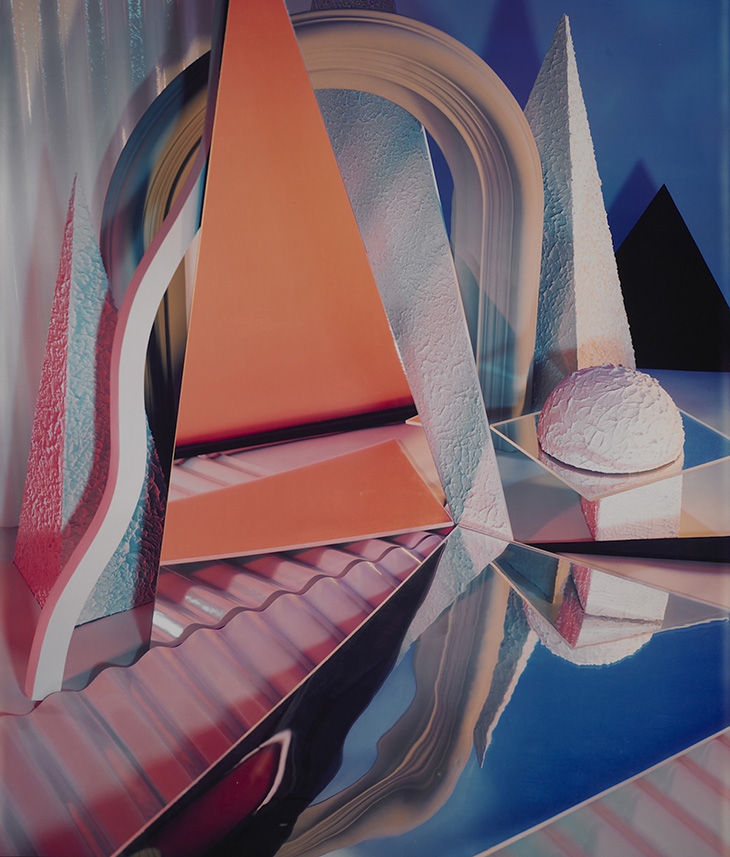
Barbara Kasten’s photos are the most colorful and abstract of the group. Using mirrors, colored lights and a variety of props to construct her conceptually driven pieces, Kasten achieves the visual effect of stage sets that mimic abstract paintings. If she was aiming to capture our constructed environment, the central premise of the exhibition, that scenario becomes a purely fictional exercise of imagination. Her photos serve to affirm the aesthetic versatility of photography in a way that activates and reveals the creative inventiveness of this wide-ranging exhibition.

Liz Goldner is an award-winning art writer based in Laguna Beach. She has contributed to the LA Times, LA Weekly, KCET Artbound, Artillery, AICA-USA Magazine, Orange County Register, Art Ltd. and several other print and online publications. She has written reviews for ArtScene and Visual Art Source since 2009.


Comments