
Crazy Hope and Safety Glass

by Margaret Hawkins
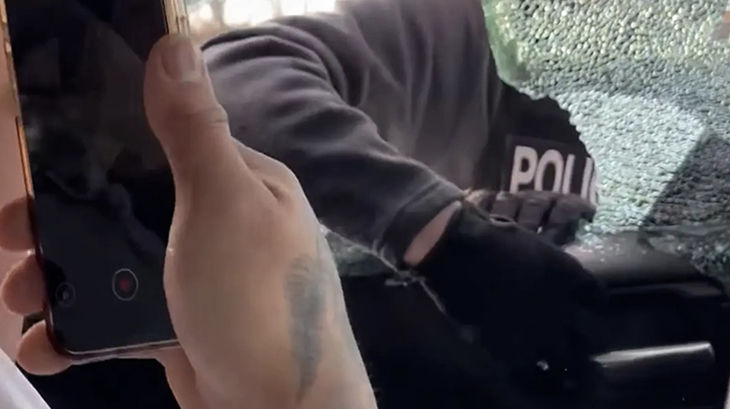
On a recent Sunday I was sitting in my 20-year-old car, waiting to merge into traffic, when I heard a loud bang next to my face. My side window had exploded and suddenly I was covered in broken glass. I thought I’d been shot. I felt myself for blood, waited for pain.
Later my mechanic told me the regulator arm had snapped when I depressed the button to open the electric window. I was lucky it was safety glass that had rained down on me.

It became a funny story about bad things being not so bad compared to what they might have been, but that first thought lingers. Something that previously wouldn’t have occurred to me now seemed quite possible, the way planes ramming into buildings became possible in September, 2001. Three days before my window blew up, Renee Good had been shot in the face, execution-style, by an ICE agent while sitting in her car in a residential neighborhood of Minneapolis. The sight, played over and over on CNN, was impossible to forget. Now it’s happened again. ICE agents fired ten shots into protester Alex Pretti while he lay restrained on the ground. In both cases, government officials are defending the killers.
People of color may be mumbling “so what’s new,” but to many this feels like an announcement: The violent unraveling of American democracy is officially underway.

The American government is starting fights, like a drunk in a bar, at home and around the world. Citizens are dragged out of their homes and deported. Protesters peacefully exercising our First Amendment rights are restrained and thrown on the ground. A foreign country is invaded. An international student emailed to say she expected to miss my first class because her passport had been questioned and she couldn’t reenter the country. Our government is blowing up boats in neutral waters. In places where our interventions are most needed, we side with the bullies. Back home, retribution for disloyalty to the established power is becoming routine. And all the while, the economy booms, for some at least. The president and his family have made over a billion dollars since his reelection; so much for the Constitution’s Emoluments Clause.
People say it all comes down to money. But money confers power, and power, ultimately, is about vanity, about being admired, loved, feared. Our president, who renamed the Department of Defense the Department of War, was so insulted that he didn’t receive a Nobel Peace Prize that he threatened to invade Greenland. Which sounds like a late-night punchline, except it’s not.

Meanwhile, our planet is flooding and burning. Microplastics have invaded all our bodies. Eighty thousand tons of plastic trash floats in the Pacific Ocean, having formed its own island, which is three times the size of France. Probably the planet will figure out a way to recover, possibly by expunging us, although it may not need to. The human world feels like it’s about to sink under the weight of its own awfulness. Violence, chaos, greed, lawlessness, and outright cruelty are tipping the ship. No one knows what will happen next, but it doesn’t look good. The Bulletin of the Atomic Scientists’ Doomsday Clock, recently announced at 85 seconds to midnight, has never been closer. There is no safety glass.
Artists, scientists, and a few honest politicians have predicted end times for a while. Ian McEwan’s latest novel, “What We Can Know,” imagines our decline from the perspective of literary historians in the future. They look back on us from the twenty-second century with nostalgia and envy. In McEwan’s vision of the future, war and environmental catastrophe have flattened Europe and North America. Both continents are half under water and what’s left is controlled by gangs. It’s a dangerous and bland world that he envisions. The rich variety of life we now take for granted — travel, food, culture, nature – has all but disappeared. Most bird and wildflower species have gone extinct. People eat laboratory food.

George Saunders, an American Buddhist who speaks like a regular guy and is famous for his philosophical kindness, offers another perspective. He says he believes in karma but that since we can’t understand it we must try to do our best not to judge each other. He urges us to remember three things:
We are not permanent.
We are not the most important thing.
We are not separate.
Imagine if this administration took his advice.
Beauty, at least for now, still abounds. Nature, when it’s not killing us, is reliably spectacular. It dazzles daily. Snow blankets the world softly today in Chicago. A fluffy baby hawk landed on our fence and sat there for a while. No doubt she’d arrived to kill something, but her feathery anatomy was gorgeous.
Even humans do beautiful things. I’m not a rabid sports fan but I can’t stop thinking about Caleb Williams’ seemingly impossible touchdown pass in the Bears’ playoff game against the Rams, tying the game with 18 seconds to go. The sportscasters described it as the best play they’d ever seen. Nobody would have predicted it was even possible. Nobody else would have tried it. But sometimes a long shot is all you’ve got.
The survival of civilization as we know it is beginning to seem like it depends on a similarly impossible-seeming Hail Mary, some mix of crazy hope, poise, and urgency. I can’t even imagine what that would be. I try not to think about the fact that, in the end, the Bears still lost.
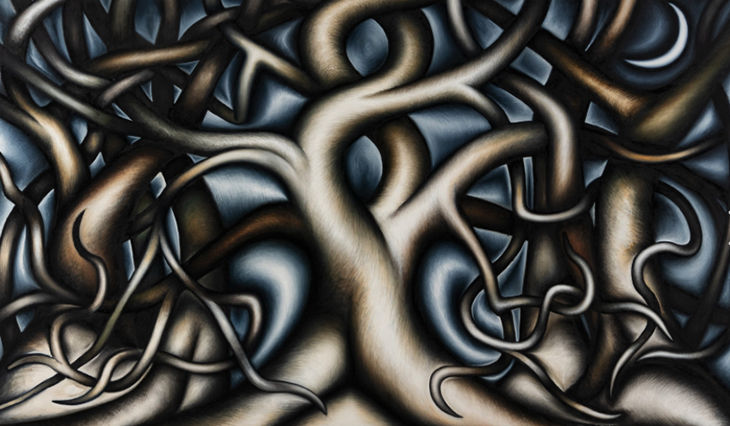
Addendum, on beauty:
On January 7 Chicago artist Frank Piatek died. He was a beautiful painter, and beloved professor at the School of the Art Institute of Chicago. He’d survived childhood polio and been selected for the Whitney Biennial at the age of 24. At 81, he was still teaching full time.
Frank held unpopular political opinions in the artist community in which he traveled, and often prefaced his opinions with the phrase “On the other hand.” He was an unusually thoughtful man, a philosopher. Three weeks before he died, he told me in his typically modest way that he was thinking of asking the school to “let” him teach part-time. It was getting hard for him to get around, he said, in his characteristically uncomplaining way. He wanted to keep teaching The Spiritual in Art, a course he’d created. Frank, a religious man open to many forms of mysticism and faith, was ushered out of the earthly realm by a Catholic priest.
Frank’s wife, artist Judith Geichman, said it best. “He led a beautiful life.”

Margaret Hawkins is a writer, critic and educator. Her books include “Lydia’s Party” (2015), “How We Got Barb Back” (2011) a memoir about family mental illness, and others. She wrote a column about art for the Chicago Sun-Times, was Chicago correspondent for ARTnews, and has written for a number of other publications including The New York Times, the Chicago Tribune, Art & Antiques and Fabrik. She teaches writing at the School of the Art Institute of Chicago and Loyola University.


Comments